Outsourcing research projects for strapped UX teams

I joined Askable+ at its inception as the sole designer. Back then, projects were run on spreadsheets, Trello, and emails. The Askable+ manager would spend all day on calls to get the brief from clients and to recruit the right researcher. I worked closely with the Askable+ manager to turn that process into product.
💬 Background
Askable is a participant recruitment tool for UX research. As a designer, I know firsthand how challenging it can be to find users to talk to. Sometimes recruiting participants is so time-consuming that research can’t be done perfectly or just isn’t done at all. Eventually we discovered that resource constraints were a common issue for our clients.
Maybe the project is too big for the team. Maybe they have bigger fish to fry. Whatever the reason, Askable+ steps in by outsourcing these projects to freelance researchers.
At its core, Askable+ comprises of 4 workflows:
Client specifies the brief, Askable quotes them accordingly.
Deadlines are set, the process is outlined so that the client and researcher have clear expectations.
Researcher goes through a certification process before they can take on projects.
Askable+ manager assigns researchers to projects and ensures the latter run smoothly.
I formed the building blocks that enabled all of this to happen via Askable. I’ll highlight some of my contributions here.
📝 Project Creation
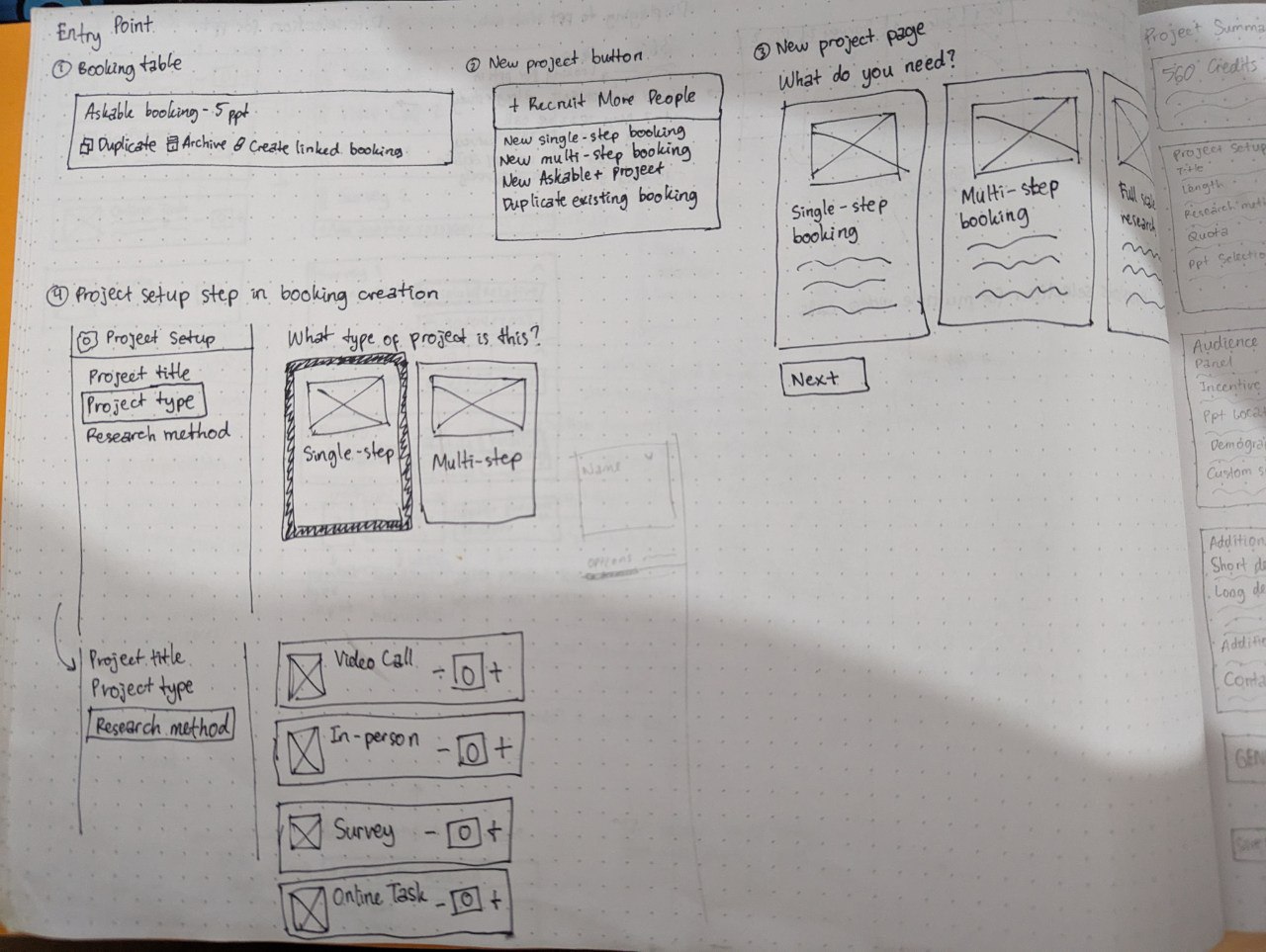
Askable+ projects can vary in both size and scope. In the early days, project briefs were sent via email. Clients were encouraged to provide as much detail as possible. To adapt project creation into the product, there were key points to take into account:
- List all the information that makes a brief — A researcher should be able to understand the project at first glance. What it’s about, the type of research it entails, the expected output, etc.
- Delegate tasks — Creating a project shouldn’t require too much thinking on the client’s part. How involved should they be in research planning? The client should know what methodology(s) to employ and what user group to target, but let the researcher worry about scheduling and writing the moderation guide. What should be in the report? Let Askable+ standardise that, but rest assured on the quality. In hindsight these decisions might seem obvious, but it took a few workshops to divvy up the responsibilities just right.
- Maintain price accuracy — It’s important that researchers are paid fairly. Estimating how many hours a project would take upfront saves Askable+ the awkwardness of asking for more payment in the middle of a project, which also leads to a better experience for the client.
I ran a session with the Askable+ manager to gather initial requirements, checking in with her and the dev team periodically as requirements evolved.
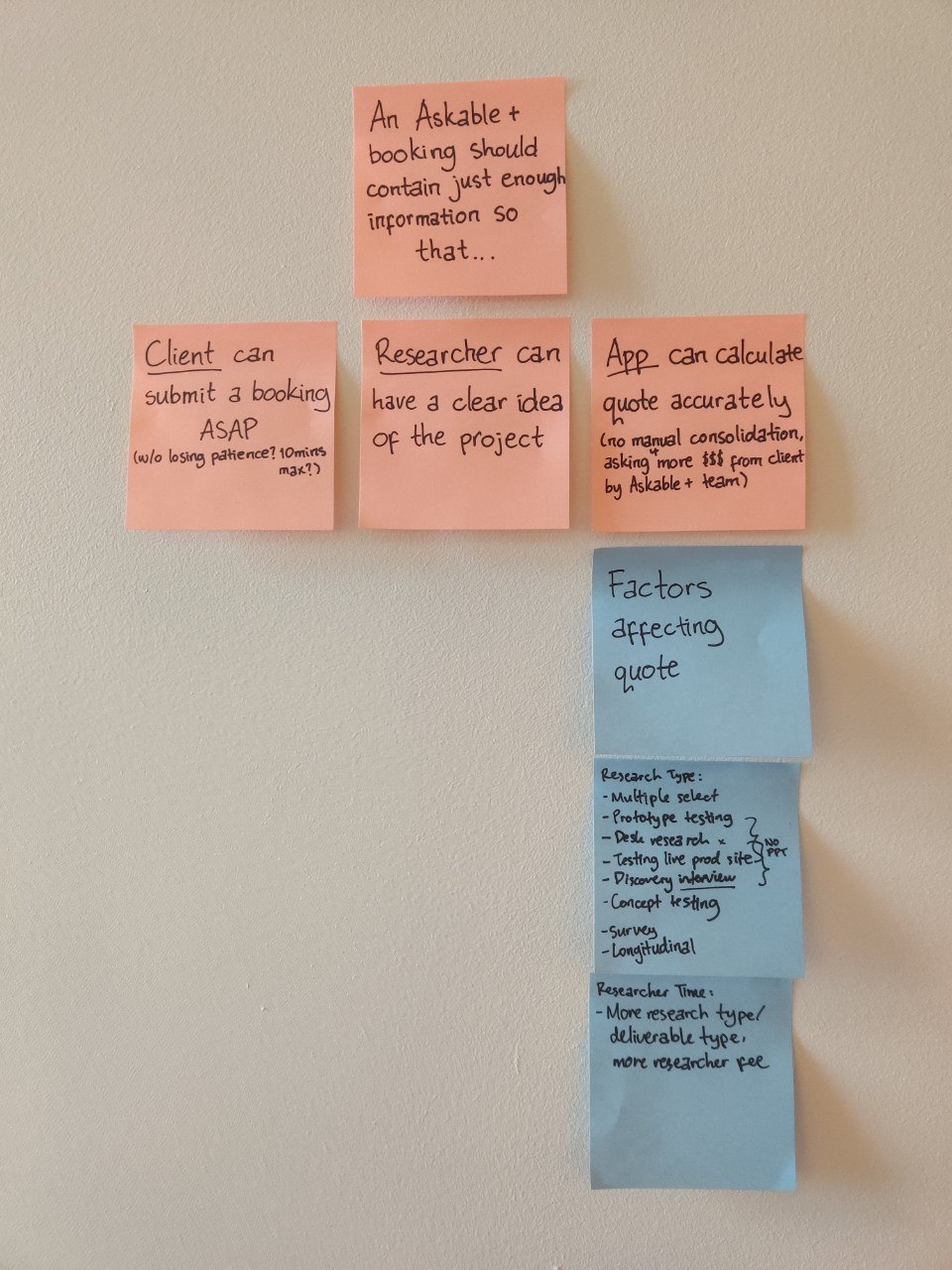
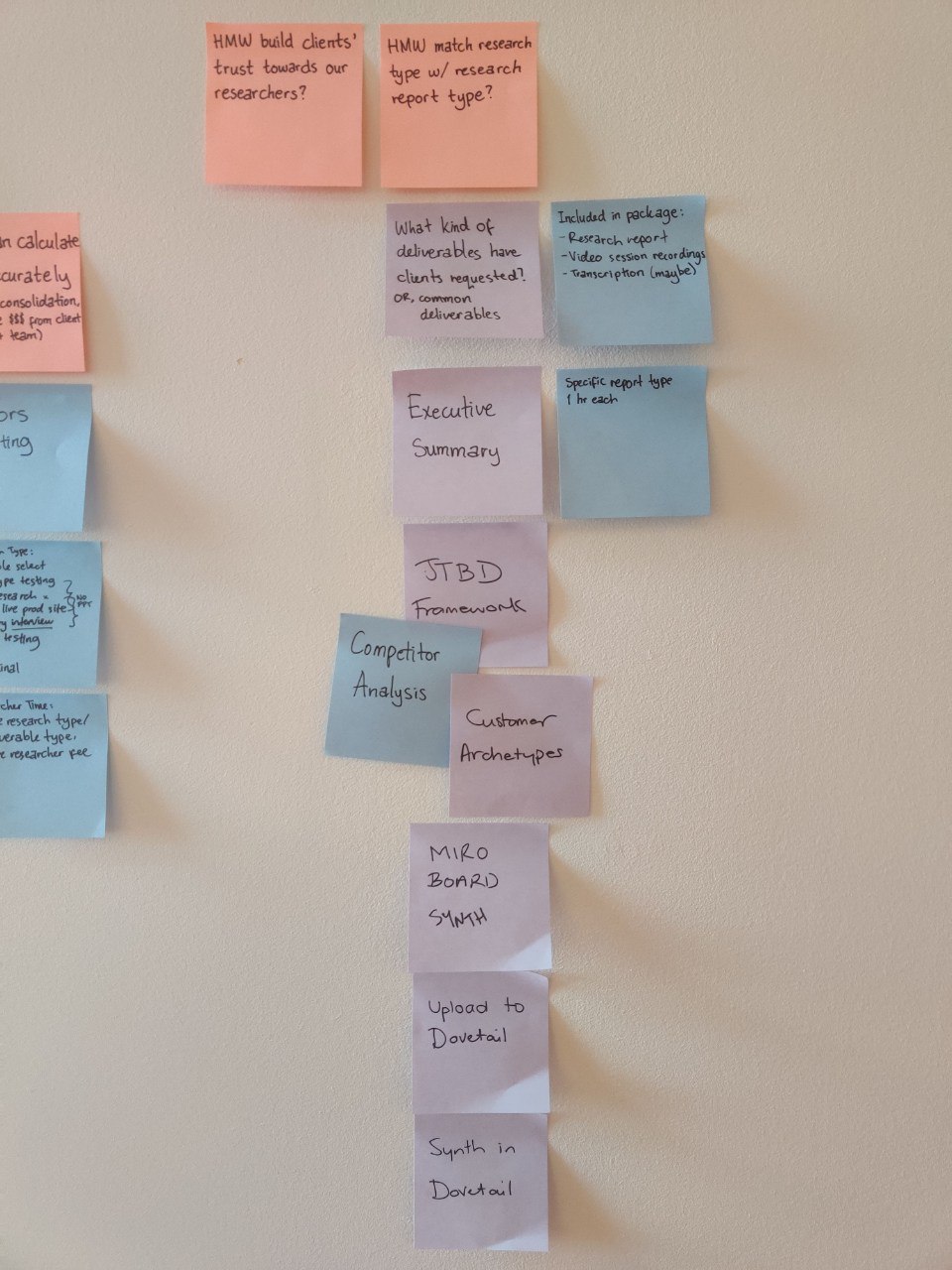
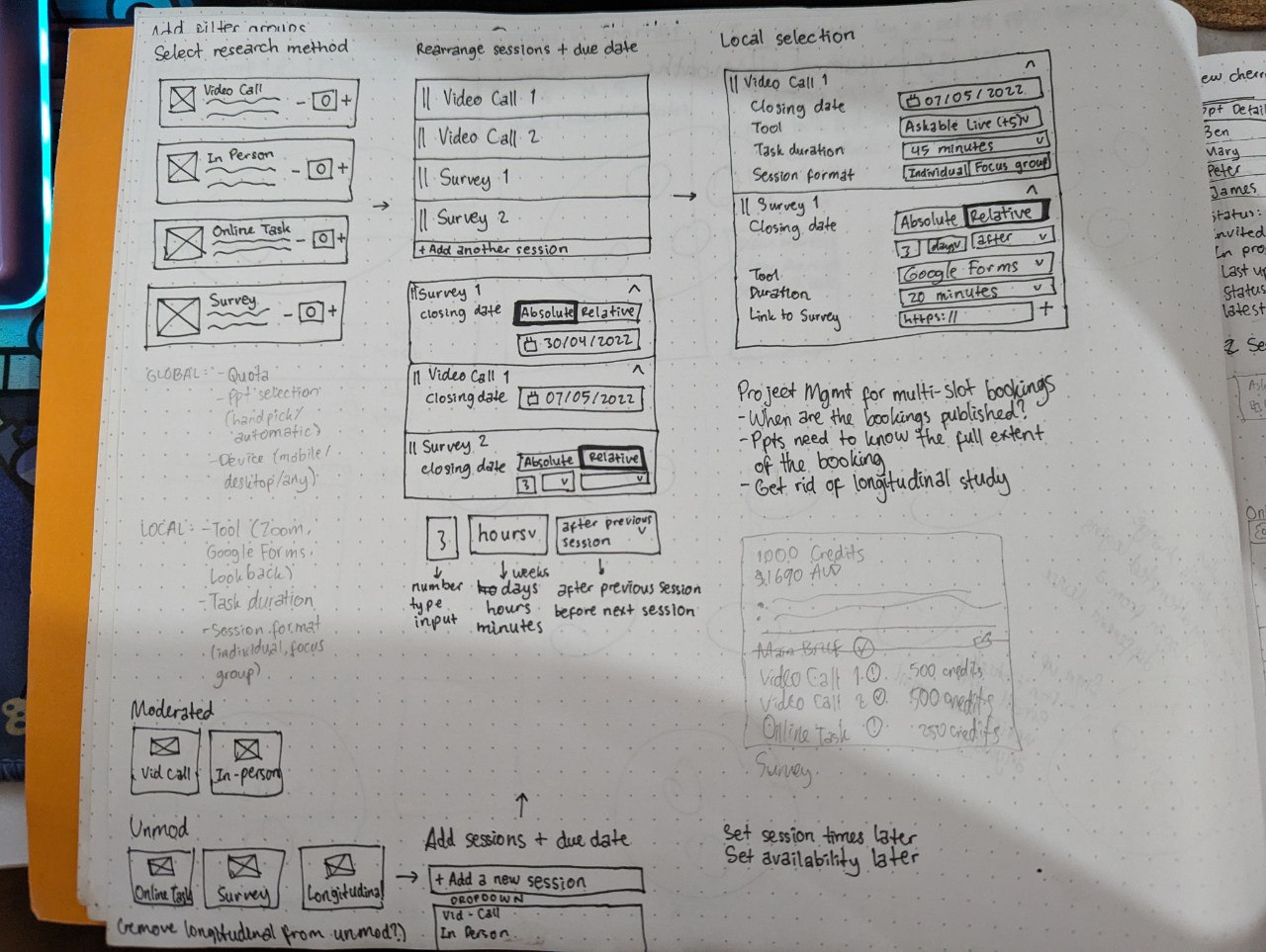
Some early sketches of a project creation page. We ended up forgoing the customisable research method selection for something simpler.
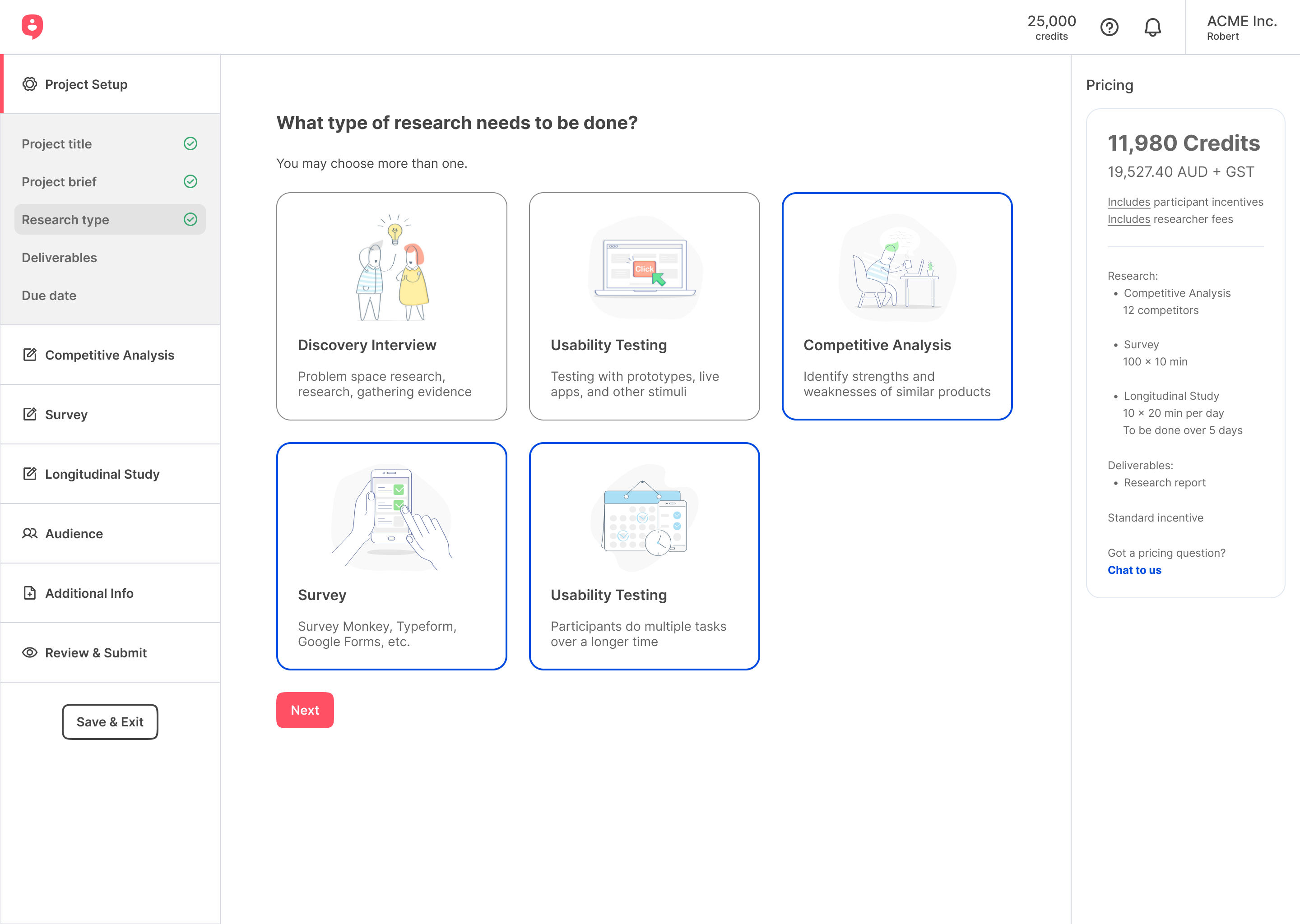
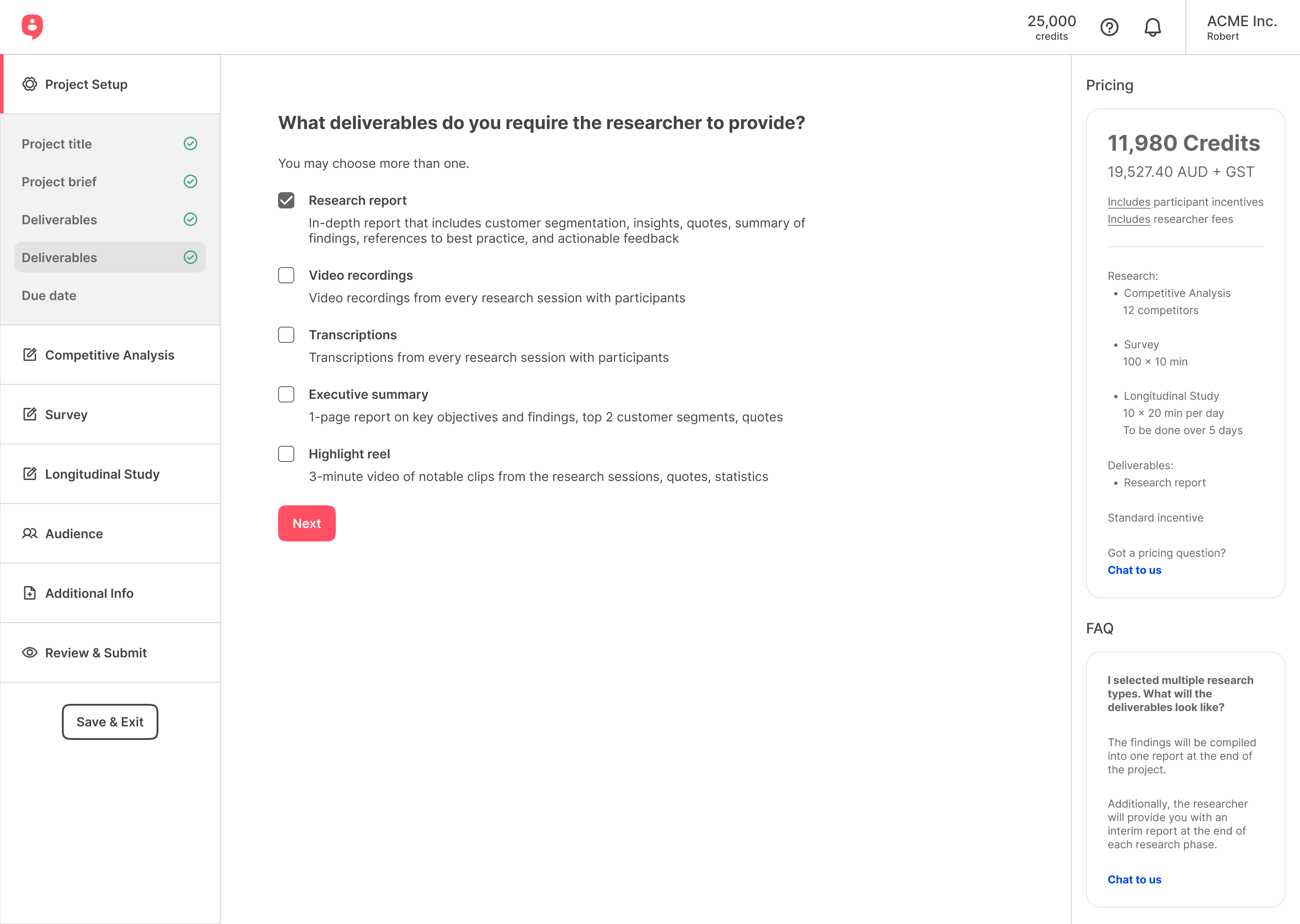
We narrowed down the project details to the following list. I used card sorting to structure the form.
| ⚙️ Project Setup |
| Project title |
| Project brief |
| Research type |
| Deliverables |
| Due date |
| 👤 Audience |
| Participant criteria |
| Incentives |
| Participant locations |
| 🗒️ Additional Info |
| Moderation guide |
| Your timezone |
| Legal & privacy |
| Link to assets |
| Additional notes |
| 👁️ Review & Submit |
| ⚙️ Project Setup |
| 📋 Discovery Interview |
| Quota |
| Session duration |
| Meeting format |
| Session format |
| 📋 Usability Testing |
| Quota |
| Session duration |
| Meeting format |
| 📋 Competitive Analysis |
| Quota |
| 📋 Survey |
| Quota |
| Session duration |
| 📋 Longitudinal Study |
| Quota |
| Session duration |
| 👤 Audience |
| 🗒️ Additional Info |
| 👁️ Review & Submit |
🚦 Project Lifetime
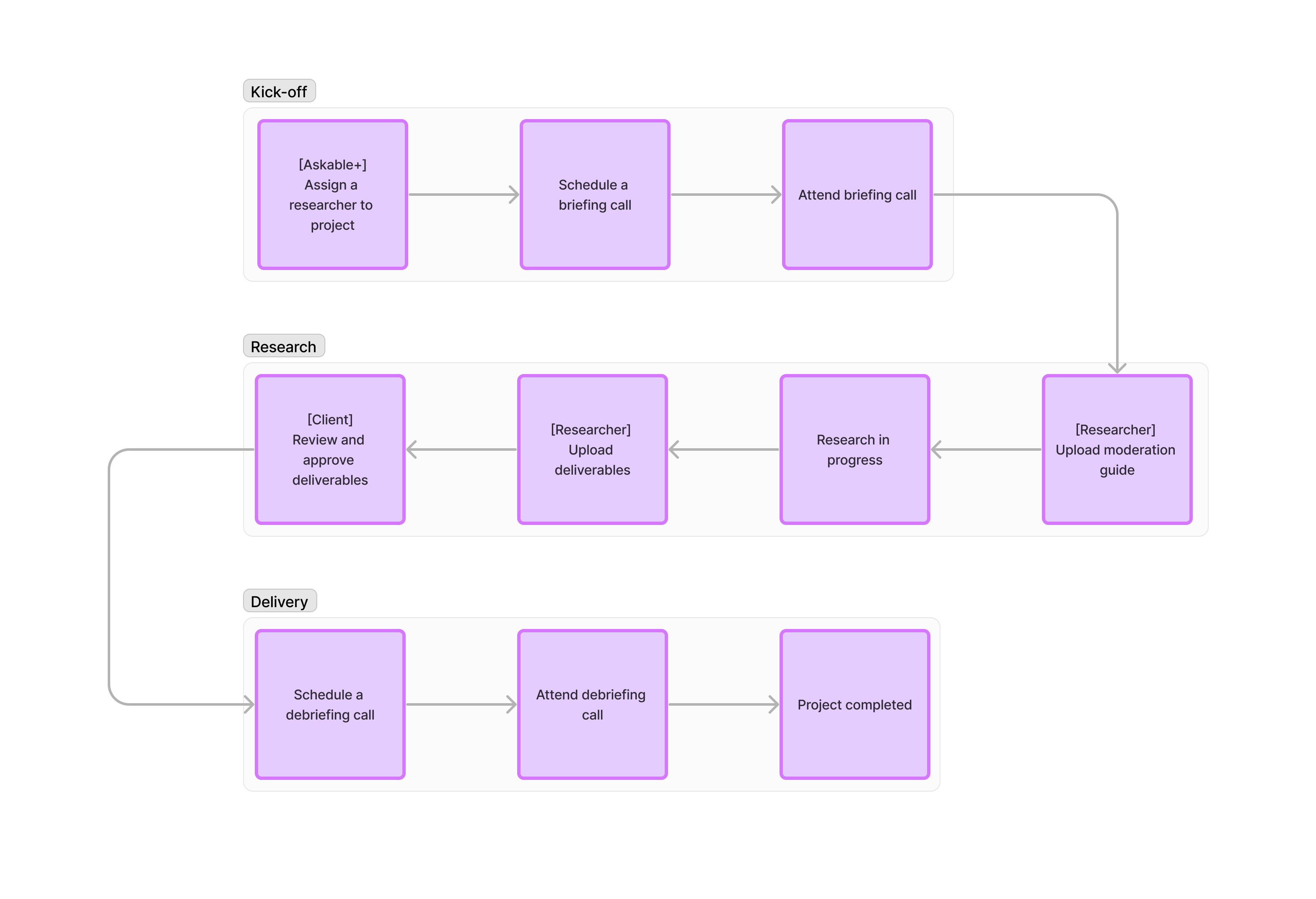
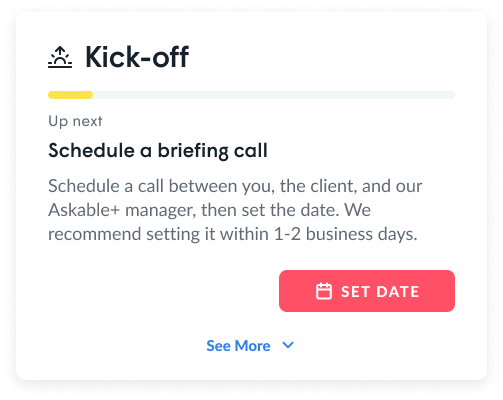
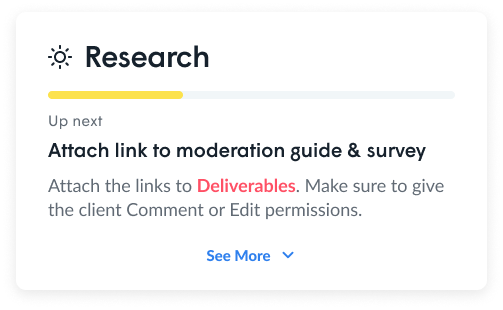
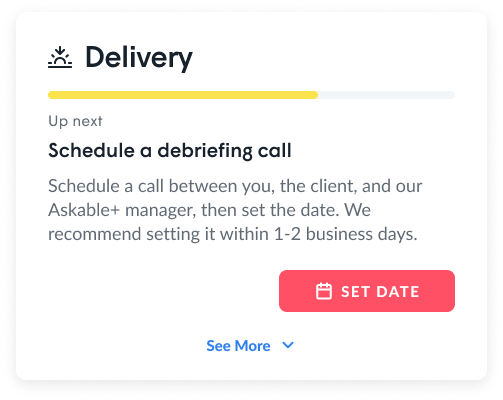
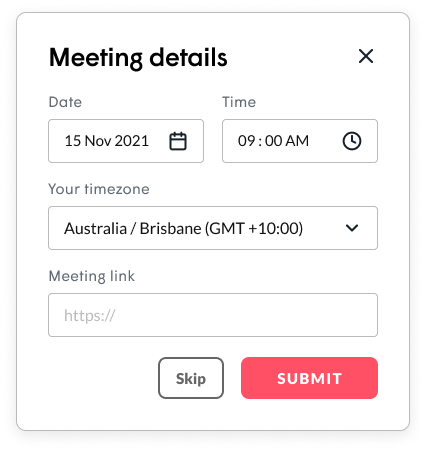
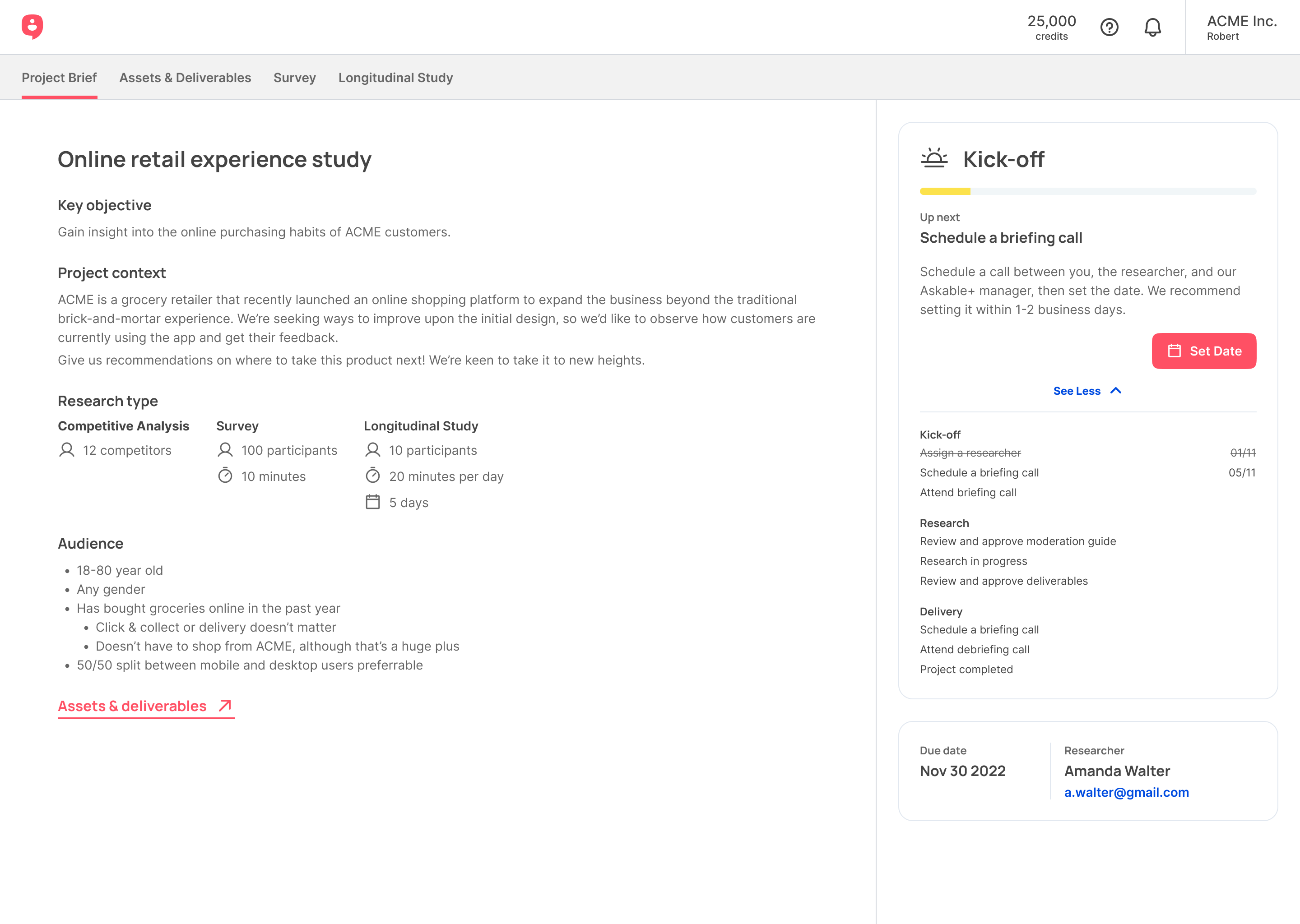
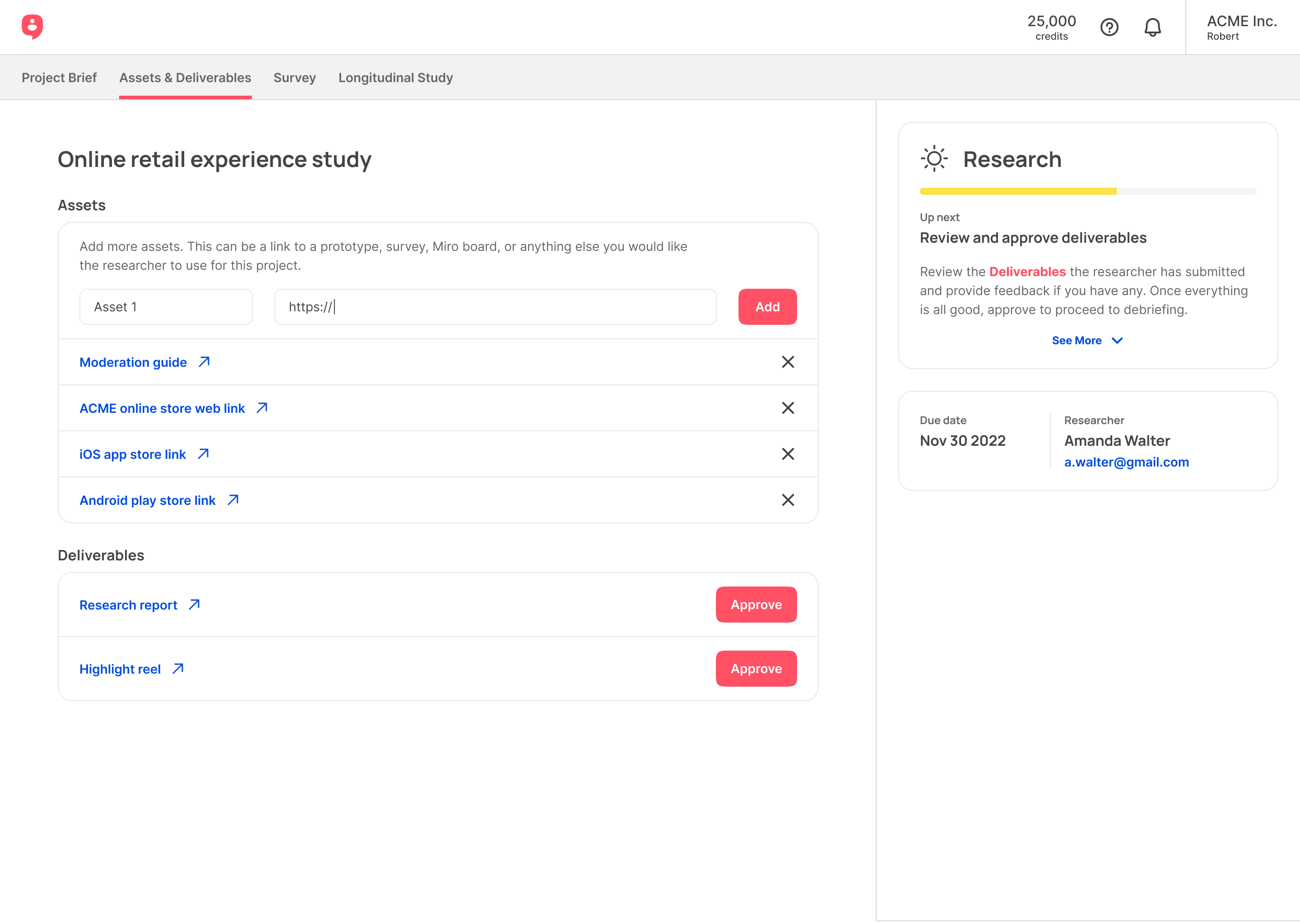
The project lifetime is rather straightforward as it seldom deviates from project to project. I observed ongoing Askable+ projects and aligned with the Askable+ manager to lay out what happened throughout a project and how/when information was getting exchanged.
🪪 Researcher Signup
To get quality results, we must first get quality researchers. Askable+ requires that every researcher undergo a certification process to make sure they’re up to snuff before we put them forth to our clients.
We mapped out the certification process to look for opportunities of improvement.
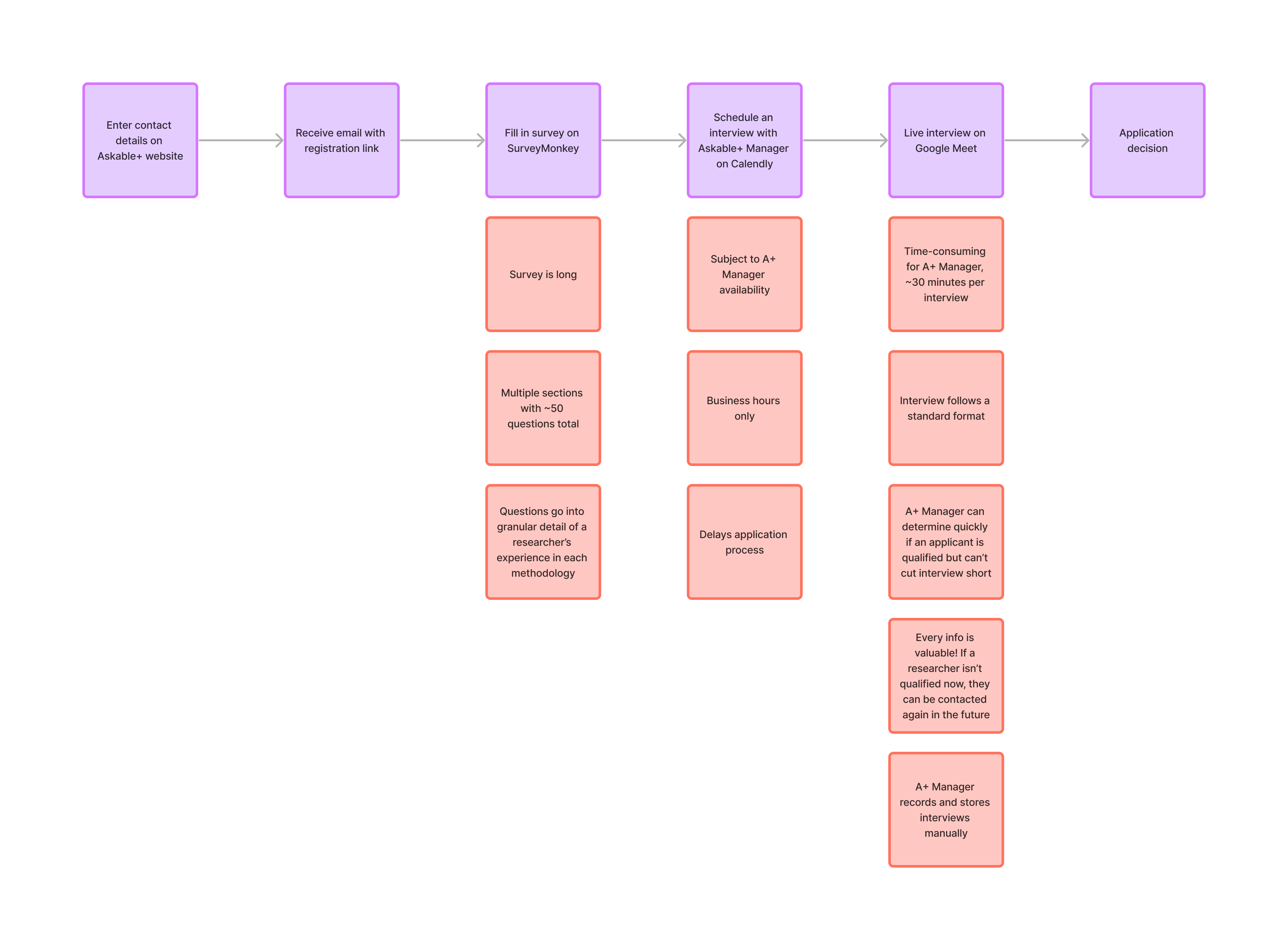
Going through the certification process, it was evident researchers were being bounced around multiple platforms, making for a confusing experience. In total, we were using 5 different platforms:
Askable+ website → Email → SurveyMonkey → Calendly → Google Meet
Moreover, certification was time-consuming. The survey could take 15-30 minutes to complete, the interview took 30 minutes, add to that the waiting time to get an appointment, and a researcher could take a few days to be certified.
As Askable+ scaled, the current process became unfeasible. The live interview in particular created a bottleneck. It took time away from more critical tasks for the Askable+ manager, and it delayed the certification process when we wanted to get researchers in as quickly as possible.
We sought to simplify and accelerate the certification process below.
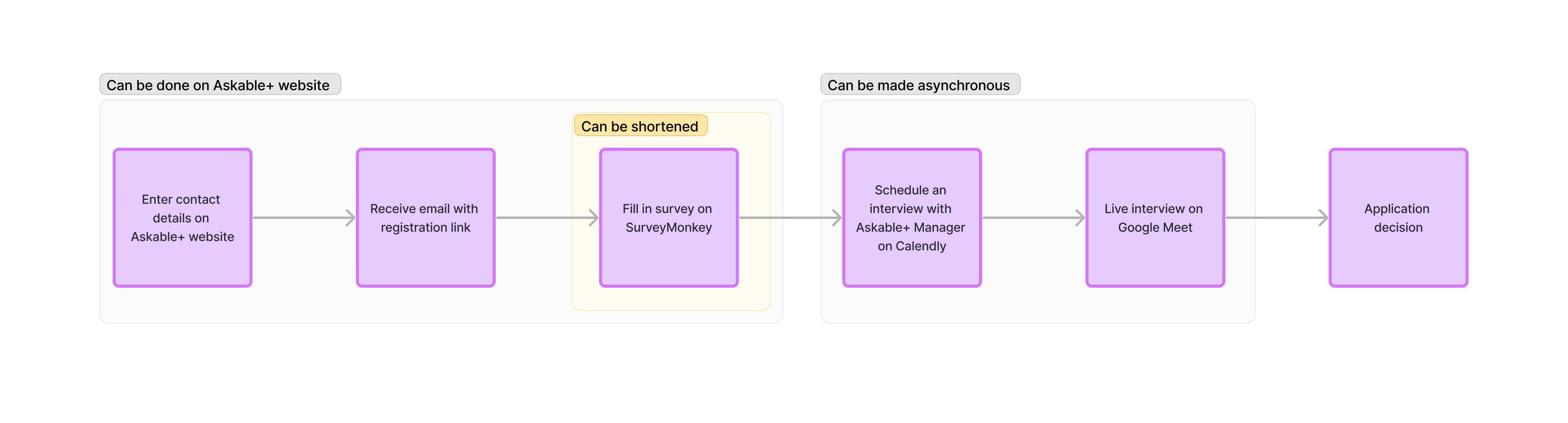
To lower the barrier to completing the survey, I asked the Askable+ manager what we looked for in a researcher. The criteria turned out to be simpler than initially thought. It could be boiled down to 3 aspects:
- LinkedIn URL — An easy way to review a researcher’s experience, in particular the industries they’ve worked in.
- Years of experience — We want at least 5. Anything less than that we’ll reject for now, but we might circle back once the researcher has gained more experience.
- Preferred research methodologies — Crucial for project assignment. We wouldn’t want to assign a researcher user interviews when they only want to do surveys.
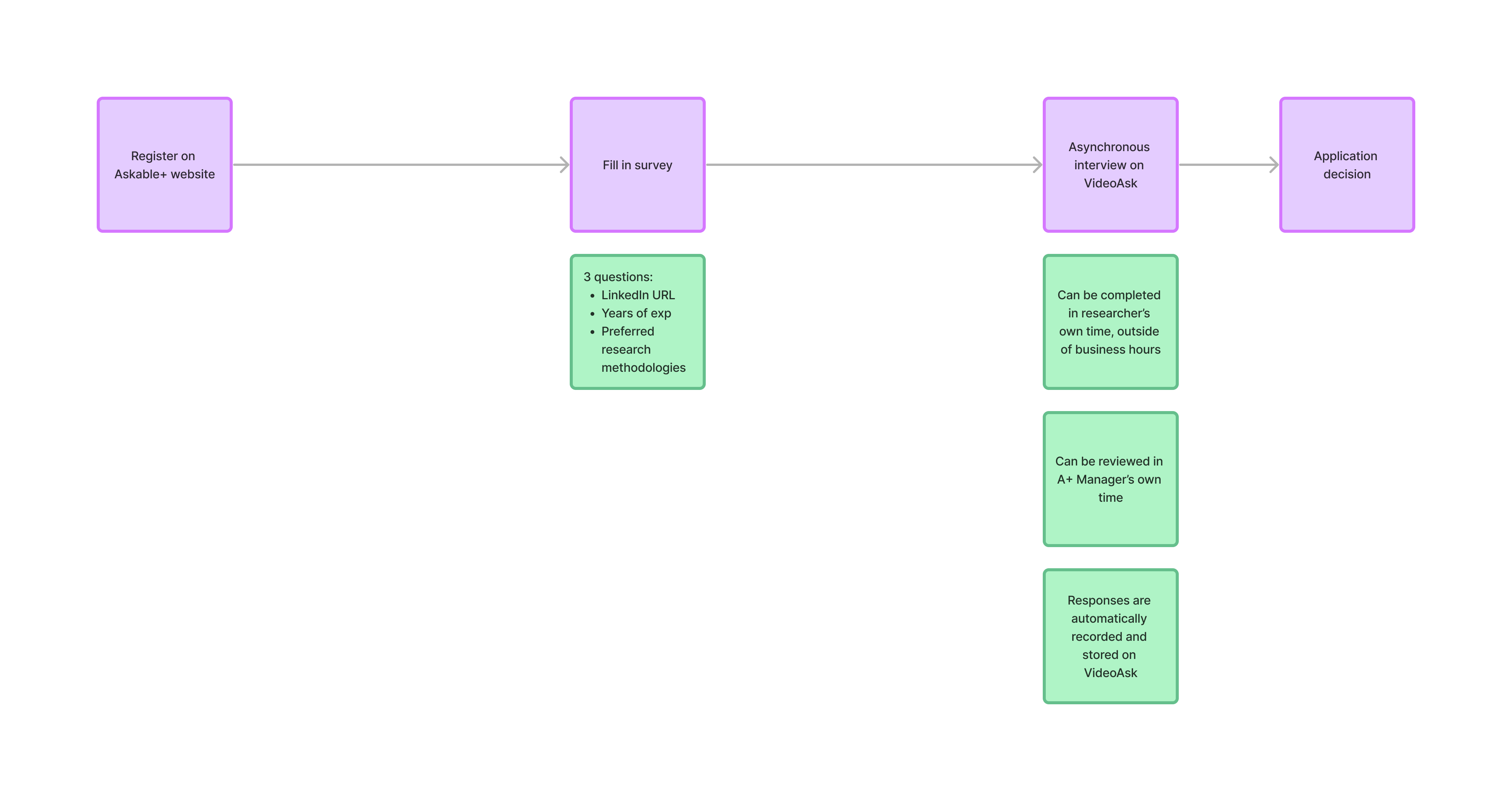
With the update, a researcher can now be certified in 20-30 minutes.